

Riverbed Optimization System (RiOS)
Using the power of SteelHead appliances running software platform
The Riverbed Optimization System (RiOS) is the software platform that powers our award-winning line of SteelHead appliances from Riverbed. Using the power of SteelHead appliances running RiOS, organizations of all sizes around the world have been able to dramatically simplify, accelerate, and consolidate their IT infrastructure. RiOS 7.0 is the latest optimization system software release from Riverbed and extends our leadership in the WAN optimization category by further increasing performance, scalability, and simplicity.
The latest RiOS release offers customers unparalleled flexibility for their WAN optimization deployment, spanning corporate data centers, branch offices, and mobile workers. The enhanced Riverbed Services Platform (RSP) lets customers run additional services and applications with VMware on a protected partition on SteelHead appliances. This enables further branch server consolidation and simplified administration, delivering significant savings to customers. With the Virtual SteelHead, customers can now take WAN optimization into specialized physical environments, such as space-limited or ruggedized environments. Other recent features include optimization for Lotus Notes, encrypted MAPI, and replication for business continuity, as well as SMB Signing support.
Any SteelHead appliance can be upgraded to take advantage of these new capabilities.
RiOS for Mobile Users
With the release of SteelHead Mobile client software, Riverbed has enabled RiOS to scale all the way down to a single user. Unlike other vendors who have tried to cobble together a solution though different acquisitions, Riverbed has taken its proven platform and optimized it for mobile workers. SteelHead Mobile enables individual users to get the same LAN-like application performance that they've come to expect from SteelHead appliances. By utilizing the same platform as the appliances, SteelHead Mobile plugs into the existing infrastructure with little or no additional work. SteelHead Mobile uses RiOS's enhanced auto-discovery features to automatically find the SteelHead appliance in the data center, which is needed to accelerate files and applications. RiOS for SteelHead Mobile has all of the key features of RiOS v5.5, although not all of the application modules are included.
| Learn More About Our Key Technologies | |||
|---|---|---|---|
| Technology | Description | Affects | Result |
| Data Streamlining | Eliminates redundant bytes from transfers Prioritizes application traffic |
All TCP Traffic, including SSL
All WAN Traffic (TCP and UDP) |
WAN bandwidth utilization reduced by 60-95 percent
Bandwidth optimized for specific applications, including latency sensitive applications like VoIP, video, and Citrix |
| Transport Streamlining | Eliminates transport protocol inefficiencies | All TCP Traffic, including SSL | Applications typically accelerated by 5-50 times, and often up to 100 times, even SSL-encrypted traffic |
| Application Streamlining | Reduces WAN round trips at the application layer | Specific Applications (see tabs for details) | Up to 98 percent reduction in packet roundtrips |
| Management Streamlining | Enables transparent deployment and centralized management | Management of SteelHead appliances | Fewer IT resources required for deployment and management |
SteelHead Appliances Accelerate all Applications
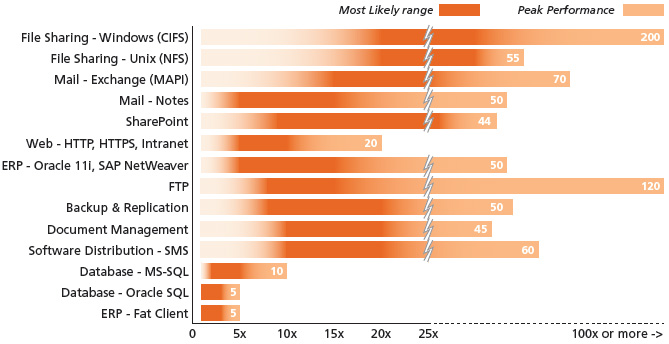
With RiOS, all key enterprise applications are accelerated across the WAN, many to LAN-like performance. The following chart shows the expected range of acceleration for some of the popular applications used by our customers:
Data Streamlining:
Key Benefits:
- UDP for Replication Solutions and IPv6
- Optimizes all TCP traffic on the WAN
- Eliminates 60-95 percent of WAN traffic
- Implements QoS mechanisms that account for both latency and bandwidth
- Helps support deployments across the enterprise
UDP Optimization
With the release of RiOS 7.0, organizations now have the flexibility to optimize applications that run on both TCP/IP and UDP, including replication solutions such as Symantec Veritas Volume Replicator, Aspera and Signiant. These applications can consume substantial bandwidth, making connectionless, packet-by-packet optimization a necessity. In addition, as IPv6 is adopted, RiOS 7.0 ensures that organizations are able to seamlessly transition without compromising performance.
Eliminate Redundant WAN Traffic
Data Streamlining optimizes all WAN traffic, typically reducing bandwidth consumption by 60-95 percent. Data Streamlining works by reducing the transmission of redundant bytes and by optionally prioritizing data based on bandwidth and latency requirements. Data Streamlining works across the key applications that enterprises care about the most, like Windows and UNIX file sharing (including MS Office), email (including MS Exchange and Lotus Notes), CAD/PDM applications, ERP, databases, and performing data reduction on all applications that rely on TCP.
No matter what application generates the data, Data Streamlining removes most redundancy from WAN traffic running over TCP. It even works across different applications. For example, a file could be emailed from someone in headquarters to a colleague in a branch. Then it might be written back to a file share in the data center, backed up across the WAN using a completely different application, and entered into a data management system or SharePoint server. In any of these subsequent transactions, Data Streamlining is intelligent enough to avoid sending the data during subsequent transactions across the WAN.
SteelHead appliances from Riverbed Technology transparently intercept and analyze all of your WAN traffic. TCP traffic is segmented, indexed, and stored as "segments" of data, and the "references" representing that data are stored on disks within SteelHead appliances on both sides of your WAN. Once the data has been indexed, it's compared to data already on the disk. Segments of data that have been seen before aren't transferred again across the WAN again; instead a reference is sent in their place that can index arbitrarily large amounts of data, thereby massively reducing the amount of data that needs to be transmitted. One small reference can refer to megabytes of existing data that has been transferred over the WAN before.
Data Streamlining is highly scalable, with peak data reduction ratios as high as 100:1. At the same time, Data Streamlining can detect very small-grained changes because the average size of a segment stored on disk is approximately 100 bytes, or about the same as a sentence of text. Even block-based differential compression approaches come nowhere near the results that Riverbed delivers.
Quality of Service (QoS)
In addition to eliminating virtually all redundant WAN traffic, Riverbed offers advanced quality-of-service (QoS) functionality. Riverbed QoS ensures sufficient bandwidth for key applications like VoIP, live video, and thin clients. Yet unlike other QoS implementations, the Riverbed Optimization System (RiOS) allows you to tune your SteelHead appliances to allocate the minimum amount of bandwidth required by accounting for the impact of latency, rather than having to overcompensate by allocating more bandwidth per application then what is really needed. Also, by using the Hierarchical Fair Service Curve (HFSC) method for scheduling, the effect of latency is also taken into account for real-time traffic such as voice, video, and desktop virtualization protocols. Data streamlining is flexible enough to work with any existing QoS implementation as well.
Hierarchical QoS
With RiOS's Hierarchical QoS, customers can define different QoS rulesets per site as well as tier class configurations.
Transport Streamlining:
Key Benefits:
- Eliminates 65-98 percent of TCP packets required to transfer data
- Accelerates encrypted (SSL) traffic like HTTPS
- Optimizes both low- and high-bandwidth connections
Transport streamlining improves the performance of TCP-based applications by improving the way transport protocols behave on WANs, reducing the number of TCP packets required to transfer data by 65-98 percent. Transport Streamlining overcomes the limitations of TCP by adapting transmission characteristics such as window scale, loss handling, congestion notification, and more.
Transport Streamlining now supports the acceleration of encrypted SSL traffic (like HTTPS), which means that even your secure business applications can benefit from the award-winning application acceleration from Riverbed Technology.
For high-bandwidth WAN links (also known as “Long Fat Networks”, or “LFNs”) components of Transport Streamlining known as high speed TCP (HS-TCP) and Max-Speed TCP (MX-TCP) may be activated, which enables greater bandwidth utilization, providing the capability to “fill the pipe” more effectively. MX-TCP also helps when dealing with lossy network connections.
The Riverbed Optimization System (RiOS) is designed to adapt to network conditions on-the-fly, responding to events such as congestion or packet loss without giving up the reliability and scalability that make TCP the de facto standard. With transport streamlining, enterprises can be assured that their networks are optimally transferring data.
Unlike other products which may implement one or two features designed to optimize TCP, RiOS implements both patented and industry-accepted features in order to fully maximize the power of TCP:
- Virtual window expansion
- Window scaling
- Delayed and selective acknowledgments (RFC 2018)
- Explicit congestion notification (RFC 3168)
- Limited and fast re-transmits (RFC 3042 and RFC 2582)
- Adaptive initial congestion windows (RFC 3390)
- Slow start with congestion avoidance (RFC 2581)
- Bandwidth delay control
MX-TCP vs. HS-TCP
Most terrestrial WANs have a very low natural packet loss rate, normally well under 0.1 percent, and often under 0.01 percent. Some enterprises may be dealing with lossy or dirty circuits however, so it's imperative that any WAN optimization solution know how to deal with both clean and lossy connections.
On clean long fat network (LFN) circuits, features like HS-TCP enable higher bandwidth utilization because they ramp up faster and back off more slowly in the face of any congestion or loss. HS-TCP behaves like regular TCP when dealing with other traffic on the same connection, and will back off so all senders can transmit on the link.
On lossy LFN circuits, or on clean LFN circuits where an administrator can guarantee a certain amount of bandwidth, MX-TCP is a better solution. MX-TCP will use 100 percent of an allocated amount of bandwidth until a transfer has been completed. It will not back off in the face of packet loss, it merely resends any lost packets.
Application Streamlining:
Key Benefits:
- Additional performance for key enterprise applications
- Incremental data and transport streamlining
- Eliminates up to 98 percent of transactions required to transfer data
- Enables transparent pre-population, file services, disconnected operations, and more
The Riverbed Optimization System (RiOS) is based on an application-independent foundation that accelerates all enterprise applications, but also provides a mechanism to add additional acceleration for specific applications that suffer most from the effects of high latency. Application streamlining is the realization of that flexibility and power.
Application streamlining can provide an additional order-of-magnitude improvement in application performance, over and above what is provided by data streamlining and transport streamlining, by reducing application-protocol chattiness up to 98 percent and minimizing application overhead.
Today, RiOS includes additional application performance via application streamlining for the following protocols:
- CIFS for Windows and Mac clients (Windows file sharing, backup and replication, and other Windows-based applications)
- MAPI including encrypted email (Microsoft Exchange – v 5.5, 2000, 2003, and 2007 are all supported)
- NFS (v 3.0 – UNIX file sharing and Unix-based applications)
- HTTP (web applications)
- HTTPS (secure web applications)
- MS-SQL (database applications)
- Microsoft Office
- Lotus Notes
- Oracle 11i and 12
- Central printing
RiOS also includes important features for maximizing branch office productivity, such as file server capabilities and the capability to pre-populate SteelHead appliances from Riverbed Technology, or even file servers with popular data. The optional feature known as Proxy File Service (PFS) also supports disconnected operations so that files can be accessed by users in branch offices even if a WAN connection fails.
Management Streamlining:
Key Benefits:
- Enables transparent deployment and centralized management
- Management of up to 500 SteelHead appliances from Riverbed Technology from a single screen
The Riverbed Optimization System (RiOS) simplifies the deployment and management of application acceleration infrastructure by employing a transparent approach to communications. RiOS enables easy deployment through the auto-discovery of peers and the auto-interception of traffic, with no reconfiguration of clients, servers, or routers necessary.
RiOS simplifies ongoing management by providing simple but powerful web-based and command-line interfaces and reporting, as well as integrated, centralized management and configuration. RiOS also enables a host of additional management features, including dozens of deployment configurations, capabilities for redundancy, optional IPsec encryption, RADIUS/TACACS+ authentication, NetFlow support, and SNMP traps.
RiOS provides significant functionality to streamline the deployment of SteelHead appliances, including:
Reporting:
- Optional centralized management and configuration via the Central Management Console (CMC)*
- Web and CLI-based management for each SteelHead appliance
- Easy-to-use, customizable reporting
- Aggregated reporting
- Configuration profiles
- Trending to one year
- Time-period zooming
- Pass-thru traffic visibility
*Also available as a Virtual Edition (CMC-VE)
Deployment:
- Transparent deployment, with no tunnel pre-configuration necessary
- Hot-backup capabilities (serial or parallel)
- Support for a wide range of in-path and out-of-path deployment options
- Device auto-registration and one-step configuration
Management:
- Over-the-wire upgrades
- Group and individual management
- Port and application auto-discovery
- Multi-hop auto-discovery
- Secure auto-registration
- Enhanced active-active failover
- SSL key management
- MX-TCP management
- More statistics about traffic & devices